
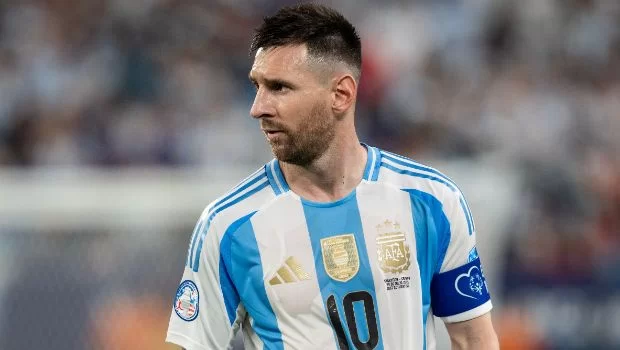
On October 16, 2004, during a tight 1-0 win for Barcelona against their local rivals Espanyol, coach Frank Rijkaard decided to make a tactical change in the 82nd minute. He brought on a 17-year-old Argentine named Lionel Messi to replace Deco, who had already secured the match's only goal.
Back then, he was just a wiry, shaggy-haired teenager who had joined the academy from Newell’s Old Boys as a small kid of 13. While those first eight minutes on the pitch didn't result in any immediate fireworks, they were the spark for everything that followed. He spent most of that 2004–05 campaign honing his skills with Barcelona B, and it wasn't until May of that year that he finally found the net for the first team.
This past Wednesday marked exactly 20 years since Messi first stepped onto the professional stage, kicking off a career defined by unprecedented success. His trophy cabinet is staggering: three Club World Cup titles, nearly 20 domestic trophies, a collection of Golden Boots and Ballons d'Or, over 800 career goals, 50+ hat-tricks, and a record-breaking number of assists that stands alone in football history.
The list of achievements continues with eight Ballons d'Or, four Champions League crowns, a World Cup victory, Olympic gold, two Copa America titles, and 12 league championships (plus a Supporters’ Shield). ESPN recently named him the greatest footballer of the 21st century and the third-best athlete overall in that timeframe. Even in his 'off' years, his performance levels remained world-class, while his peak seasons redefined the limits of the game.
Every legend has a starting point. Messi entered the professional world at the age of 17 years, 3 months, and 22 days. He spent his early days primarily with Barca B, often coming off the bench to make his mark across 17 games and 6 goals. His first senior goal arrived on May 1, 2005, against Albacete, courtesy of a brilliant, trademark dinked pass from Ronaldinho—the first of a lifetime of goals.
Let's shift the timeline for a moment to look at the later stages of his career. One of the most surprising chapters was his tenure at PSG. Messi's departure from Barcelona in 2021 was heartbreaking, forced by the club's crumbling finances—ironically exacerbated by the massive spending intended to keep him happy. For much of the 2021–22 season, his impact on the pitch seemed strangely subdued.
Despite the adjustment period, Messi proved his worth in the Champions League with five goals during the group stages. He formed a formidable partnership with Neymar and Kylian Mbappé, helping PSG cruise to a Ligue 1 title. However, his most inspiring moments came with the Argentine national team over the summer, where he netted five goals in a friendly against Estonia and provided two crucial assists in the Finalissima win against the European champions.
Since the MLS schedule doesn't align with the European calendar, we have to adjust the timeline slightly. Since arriving at Inter Miami in July 2023, Messi has spent about 15 months in the league. Accounting for injuries and age-related breaks, he has appeared in 35 matches—roughly the length of a full season. Because of this, we're grouping his current impact into a single 2023–2024 period.
His time in the MLS has unfolded exactly as you'd expect from a player of his caliber. With 0.72 assists per 90 minutes, he's actually performing better than during his 2011–12 peak at Barca when he recorded 30 assists. His scoring rate of 0.99 goals per 90 is his highest in five years. The magic started immediately in his debut, where he scored a dramatic stoppage-time equalizer.