

Share this story
Success isn't overnight; it's the result of years of sweat, persistence, and sacrifice. But while the climb is slow, the fall can be immediate. A flourishing reputation can be obliterated in a heartbeat by nothing more than sheer greed. This is precisely what happened a year ago to David Warner, Steve Smith, and Cameron Bancroft. In just two days, the Cape Town ball-tampering scandal tore through their careers and public images. Not only were they immediately ousted from the South African tour, but they returned home to a wave of public fury, with the Australian Prime Minister himself condemning their actions on a global stage.
Of the three, David Warner bore the brunt of the public's anger and isolation. Reports suggested he was the mastermind behind the plot, while Bancroft was viewed as a pawn following orders, and Smith was criticized for his failure as a leader to prevent a crime he knew about. While many felt a sense of pity for Smith and Bancroft after their emotional apologies, the public had very little sympathy left for Warner.
Warner's fall was staggering. He went from being a national treasure—a back-to-back Allan Border Medalist and a recognized 'Sports Dad of the Year'—to becoming one of the most vilified figures in the sport. Suddenly, the applause stopped, and he found himself isolated, avoiding the spotlight and seeking refuge in anonymity as he dealt with the weight of the scandal.
But Warner wasn't the type to hide forever. He used his time away from the game for deep introspection, attempting to understand the gravity of his mistakes. During his one-year ban from international cricket, the Australian board allowed him to rebuild his game by playing in grade cricket and various T20 leagues across the globe.
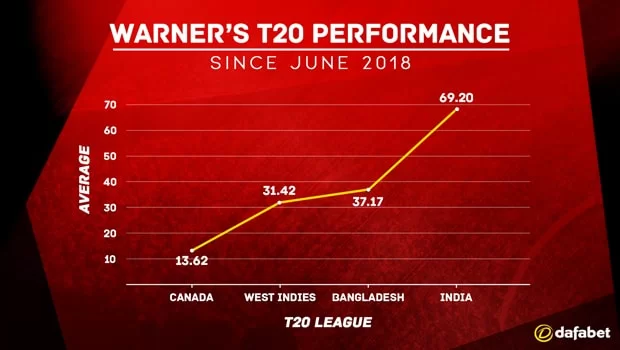
His journey back to the top began with the Winnipeg Hawks in Canada's Global T20 League, though it was a rocky start; he struggled significantly, managing only 109 runs across eight matches. Things improved slightly in the Caribbean Premier League, where he averaged 31.42, but his strike rate suggested he hadn't yet regained his explosive edge. It wasn't until he joined the Sylhet Sixers in Bangladesh that he started feeling like himself again, posting a strong strike rate of 131.17 before an elbow injury unfortunately cut his campaign short.
Once recovered, he entered the Indian T20 League, and the results were nothing short of spectacular. He opened the 2019 season with a fiery 85 at Eden Gardens and closed it with another commanding 81. By the end of the tournament, he was the leading run-scorer with 692 runs at a staggering average of 69.20. A magnificent century against Bangalore in Hyderabad served as the ultimate proof that he had returned to his peak. With the Australian selectors watching his every move to decide his World Cup fate, Warner left them with no choice but to pick him.
Indian T20 League and what happened next is well documented in the record books. He started the 2019 season with a blistering knock of 85 off just 53 deliveries against Kolkata at the Eden Gardens and bid adieu to the season with another trademark knock of 81 runs, thus ending up as the highest run-getter in the tournament with a tally of 692 runs in 12 innings at a mammoth average of 69.20. Those runs include a superb century against Bangalore at Hyderabad, and that very knock had shown that Warner is back at the peak of his abilities. The Australian selectors had openly conveyed that the opener’s T20 League form will be considered for World Cup selection and Warner didn’t give them any chance to complain with his fabulous showing.
The dark days are now behind him, and Warner is once again stepping into the light. He has reclaimed his form; now, the final piece of the puzzle is winning back the affection of the fans in Australia, and a strong World Cup performance is the perfect way to do it.
Written by: Prasenjit Dey