
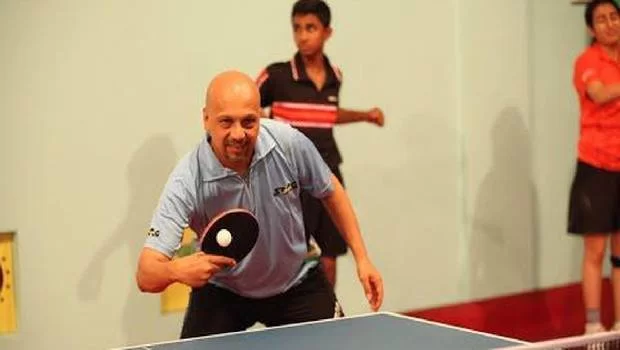
When Kamlesh Mehta, India's first major table tennis star and an 8-time national champion, competed in the 1988 Olympics, it was his first real introduction to the concepts of physical training and proper nutrition.
By the time Achanta Sharath Kamal—the revolutionary figure who redefined the sport in India and broke Mehta's national record—made his Olympic debut in 2008, his preparation consisted of only a few basic training sessions across India and Europe.
The year 2021 marked a turning point as four Indian players—Sathiyan Gnanasekaran, Sharath Kamal, Manika Batra, and Sutirtha Mukherjee—qualified for the singles events at the Tokyo Olympics. Additionally, Sharath Kamal and Manika Batra secured a place in the mixed doubles category by overcoming the top-seeded players at the Asian qualification tournament. Although this was a milestone victory, it felt like a natural result of the sophisticated, modern training methods the Indian team had embraced.
In an interview, Mehta recalled that when he qualified for the Olympics at age 20, scientific approach to training was virtually unknown to him. His only experience with the discipline was a stint at a high-performance gym in Mumbai under Dr. Swati Piramal, where his diet and calories were professionally evaluated for the first time.
Sharath's road to the Tokyo Games began in November 2019, though the pandemic forced a break in his training until he was able to resume in October 2020.
Discussing his routine, Sharath noted that he now has a much better grasp of how to time his peak performance, knowing exactly how many matches are needed to reach top form. He feels that focusing on both the technical and physical demands of major tournaments has turned his preparation into a more scientific process. For nearly twenty years, Sharath has remained the primary ambassador and face of the sport in India.
These examples highlight the dramatic transformation the sport has undergone in India recently. While table tennis might not always dominate the national sports conversation, there is a deep sense of pride and celebration whenever Indian players achieve these hard-won successes on the global stage.